skip to main |
skip to sidebar
Holy crapparoni, I’ve missed 2 days of MoFo’ing. I gotta get my ass into shape…
What I’d like to share today is a vegan version of another childhood favorite: puchero.
I think this dish is something every Filipino family has its own version of. Puchero actually came from Mexican and South American cuisine. It arrived in the Philippines via Spain and I guess, puchero is one good thing we can thank our colonizers / slavemasters of 300 years for.
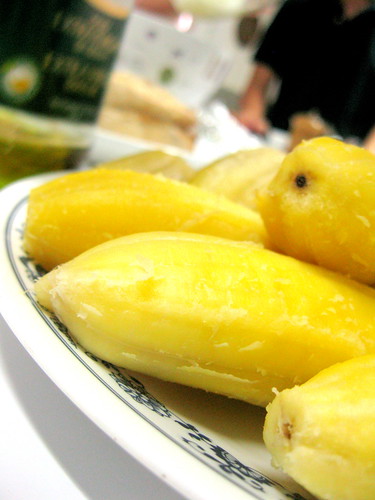
Puchero, Spanish for “stewpot”, comes from Argentina, Uruguay, and Spain. According to Wikipedia, the preparation and ingredients of the dish vary by region. Spain particularly likes chickpeas while Argentina and Uruguay like theirs meat-based. Puchero is usually made up of a soup of meat and vegetables. Here in the Philippines we use chicken, beef, cabbage, baguio pechay / Chinese cabbage, and potatoes. We also like having boiled saba / cooking bananas served on the side. For families who can trace their roots to Spain (fun trivia, on my paternal grandfather’s side we get our Spanish blood from a friar), we like adding chorizo / pork sausage and chickpeas. I believe puchero is usually eaten as a hearty soup but for those with Spanish influences, we like ours soup on the side, meat and veggies served separately, and with rice.

I fondly remember the Sunday puchero tradition upheld in my family. We usually chop up the meat and veggies and mix it with rice, tomato sauce, olive oil, and vinegar in a huge wooden bowl. Each of us had an assignment, whether it’s chopping the meat, or the veggies, or pouring the sauce. My dad usually added the final touch, whether it was a splash of vinegar or a dash of salt. It was a family affair and it was so satisfying to sit down and eat the fruits of our labor.
When my brother Michael and I turned vegan, we no longer joined in this tradition. We missed the family food preparation. When everyone else would enjoy the puchero, we would have some completely different vegan meal.
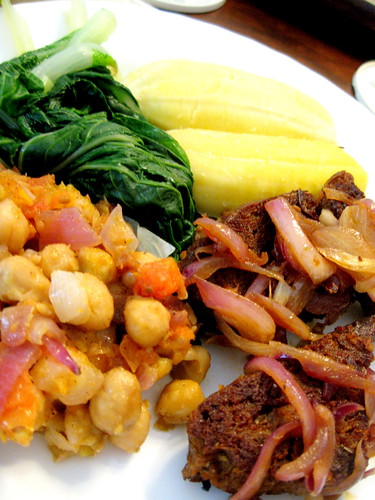
Last Sunday we had puchero for lunch and for the first time we were able to enjoy a vegan puchero! It felt completely familiar at once and incredibly satisfying to eat. We missed our puchero. For our version we cooked our vegetables (cabbage and baguio pechay) and saba bananas in gently boiling water until tender. Chickpeas, usually an afterthought, became one of the main stars of the dish. We cooked ours in garlic, onions, tomatoes, salt and pepper.
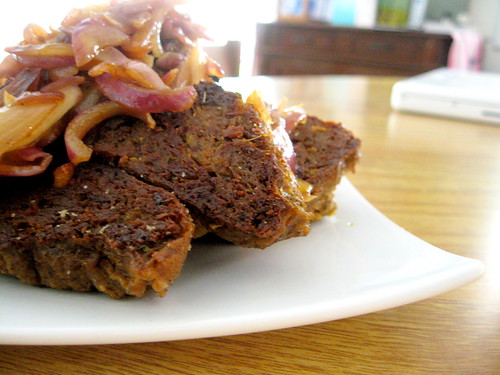
 And I confess, I missed chorizo – or rather, the smoky saltiness it imparts. Luckily I had a stash of homemade vegan chorizo (off Isa’s Vegan Brunch cookbook) in the freezer. I threw in a couple of chorizos in a sautee pan with about 1 inch of water and simmered them until tender. I then sliced the sausages in half, and then in quarters diagonally. So as not to throw out the now flavorful cooking liquid, I sautéed some sliced onions in it with a splash of olive oil until tender. After setting the onions aside, I added another glug of olive oil in the same pan and fried up the chorizos.
 Eating puchero after years of no puchero was… nothing short of amazing. We didn’t have the time to slice up the chorizo and veggies and mix it up with chickpeas, rice, tomato sauce, olive oil and vinegar like our family usually does but it was rewarding just the same. I got bits of everything and couldn’t even fit rice onto my plate.
If you come from a family that regularly eats a meat-based puchero – you can have your puchero veganified! So to summarize: - Cook vegetables and saba bananas separately from the meat.
- Gussy up your chickpeas – cook them with garlic, onions, and tomatoes.
- Fry up your favorite vegan chorizo, either store bought or homemade. Check out Julie’s Spicy Italian Sausages, they’re a good substitute.
- The puchero seasonings – tomato sauce (cooked with garlic and onions), olive oil, and vinegar – are already naturally vegan!
- Mix everything together and dig in!

Happy happy birthday to Michael, my awesome brother who turned vegan the same time I did and has been my animal-rights fighting buddy ever since. I can honestly say that vegan life would've been more difficult if not for him. He was the only vegan I knew for the longest time (until the vegans started coming out of hibernation when they heard about my bakery) and the person I'd rant to when I'd get angry about an AR-related issue. He also convinced me to adopt our cats when I was still hesitant about keeping pets.
 Here he is with my mom, my 2 other brothers Gabriel and Antonio, and the birthday pie I made for him: buko pie. Ever since my triumph with my first vegan pie, I've been dying to make buko pie.
Buko pie is one of those Filipino desserts that is usually not vegan and something that I've missed eating. Usually the pie crust is made with butter or dairy margarine, or it's got eggwash brushed on top, or the filling's made with milk. Michael requested buko pie for his birthday instead of traditional cake, and so I went on a mission to make my first buko pie.
Quick lesson: buko is the young version of coconut. While the coconut looks like a hard ball of brown hair, buko is a hard green ball. The coconut's meat is used to make coconut milk while buko meat is softer and is used fresh in fruit salad or other Pinoy icy desserts. Also, it's from the buko that we get one of the best juices in the world: buko juice.
 I immediately turned to my mom's favorite cookbook when it comes to all things Filipino: Let's cook with Nora, by Nora V. Daza, the Julia Child of the Philippines. As you can see in the photo it's been well used. A lot of the newsprint pages have been splattered with sauces and the book cover had to be wrapped in plastic because it was in a serious state of disintegration. My mom bought this in 1996 for a whopping P85. For the foreigners out there, according to this site the peso was around P26.25 to the US dollar in September '96, so the cookbook would've costed a whopping US$3.24! I believe this edition was the 1969 edition with retro drawings of the dishes.

The recipe was easily veganizable. Actually I'm surprised that buko pie isn't naturally vegan. The recipe for the pie filling called for buko meat, sugar, coconut water (aka buko juice), cornstarch, and evaporated milk. Why do people insist on using cow's milk when making a coconut dessert? What's wrong with coconut milk?
I made the 10" pie crust from The Joy of Vegan Baking (you can use VeganYumYum's pie crust recipe here). The buko pie filling recipe was for an 8" pie so I just added 1/4 more of the ingredients.
You can buy buko meat and buko juice from your local coconut purveyor, usually found in markets / palengke. I bought mine from the market in BF, Paranaque, along Palanca St. for P17 per buko. The coconut guys sell both adult coconuts and bukos -- fresh as they hack open the fruits right in front of you. For this recipe, just ask your coconut guy for the juice and meat of 3 bukos. Get the meat as a whole, don't get it slivered up. While waiting for them to prepare your order, enjoy a glass of buko juice.

Buko pie
adapted from Let's Cook with Nora by Nora V. Daza
1 prepared 10" pie crust (top and bottom)
2 1/4 c. buko meat, sliced into chunks
3/4 c. + 3 tbsp. raw sugar
1/2 c. + 2 tbsp. buko juice
1/2 c. + 2 tbsp. coconut milk
1/3 c. + 1 tbsp. + 1 tsp. cornstarch
Preheat your oven to 400 deg F.
Place the buko meat and sugar in a medium saucepan. In a medium mixing bowl, whisk the cornstarch, buko juice, and coconut milk together. Add the cornstarch mixture to saucepan.
Heat the pan on medium heat and cook, stirring continuously until thick. The consistency of the mixture should be like thick gravy. Add the mixture into the prepared crust and top it with top crust. Crimp the edges with your fingers or with the tines of a fork. Make slits on the top (or use a fondant cutter to make cute holes like I did).
Bake the pie for 30-45 min or until golden brown. Cool the pie in room temperature for several hours, then place in the refrigerator to cool down further. The pie is best served cold.
 Notes on making buko pie:
- If you want a pie with more "bite", get your buko meat malakanin. This is thicker than the usual mala-uhog type, which is softer and better suited for buko salad.
- Keep the buko meat and buko juice in the refrigerator at all times!
- I used canned coconut milk -- in fact I think I used light coconut milk. If you want a richer pie, feel free to use regular coconut milk or even coconut cream. If you're feeling domestic, why not make your own coconut milk?
- I used raw sugar to keep things white-sugar free, but feel free to use white sugar. This pie isn't super sweet so it's perfect for people who aren't into desserts. If you'd like a sweeter pie, you can increase the sugar to 1 to 1 1/4 c.
- The proportions of the ingredients was 1 + 1/4 of the recipe in the cookbook. The pie could actually use more filling, so if you want a meatier pie, try these proportions: 2 1/2 c. buko slivers, 1 c. + 1 tbsp. raw sugar, 3/4 c. buko juice, 3/4 c. coconut milk, and 1/3 c. + 2 tbsp. + 2 tsp. cornstarch.
Happy pie making!

Okay so here's a post showing my kitchen geekness / Martha Stewartness.
I hate using white flour because it has no nutrition whatsoever. But, you can't make cupcakes with wholewheat flour -- you might as well call them muffins. Or hockey pucks. Next best option should be unrefined, unbleached white flour, but that stuff's not available commercially and affordably. Healthy Options sells Bob's Red Mill organic unbleached white flour but... who can afford that stuff anyway? Who buys that stuff in this country, under these economic circumstances? Probably the expats and the class AAA's. RIght now I'm limited to refined white flour, boo.My next baking peeve is white sugar. At least in this arena we have alternatives -- brown and raw sugar. I'm trying to switch to raw sugar in my baking permanently. Quite surprisingly brown and raw sugar are cheaper than white by like three pesos (6 US cents?) at the baking supply store. According to this site:
"Unrefined raw sugar is made from the juice from the sugar cane plant and has trace minerals and nutrients present. Refined sugar is devoid of all nutrients. Typically, white sugar is made of pure carbohydrates. Today, it is common knowledge that refined white sugar has devastating affects on the body and health in general. Besides being a certain way to elevate blood sugar levels, refined white sugar is considered to be “empty calories” as it offers no nutritional substance whatsoever. Raw sugar contains minerals and nutrients that are stripped from refined white sugar. Raw sugar contains roughly eleven calories per teaspoon and has the same vitamin and mineral consistency that is found in the juice from the sugarcane plant. These minerals include Phosphorus, Calcium, Iron, Magnesium, and Potassium. In addition, when sugar is refined and processed there are many harmful ingredients that are added to the sugar as a result. Unrefined raw sugar does not have these harmful chemicals. Some of these include: Phosphoric Acid, Sulfur Dioxide, and Formic Acid."
 Raw sugar: the lesser of 2 evils
I've seen recipes for homemade powdered sugar in a couple of vegan cookbooks which I've been dying to try out. I finally was able to experiment last week. I used the recipe from Eat, Drink and Be Vegan. Pretty straightforward: blend 1 tablespoon of cornstarch and 1 1/4 to 1 1/2 cups of sugar for a few minutes until powdery. Instead of cornstarch I used sweet potato starch; instead of white sugar I used 1 1/4 cups packed raw sugar. In the homemade-powdered-sugar arena, blenders are superior over food processors.
It did take me a few noisy minutes to come up with homemade powdered sugar. I also had to stick a knife in to occasionally break up the clumps (turn off the motor when doing this). Here are the results:
 Left: the devil's posion. Right: the homemade stuff.You can see that powdered sugar made from raw sugar is a little honey-colored while that refined stuff is dead white. Homemade doesn't clump up as much because of the blender -- obviously blenders made for the home cook / baker are less powerful than industrial blenders made for corporations. I think the powdered raw sugar granules are heavier than their white counterpart, hence its non-clumping qualities. The texture is actually slightly coarser but it will still be able to pass through a sieve. Oh yeah, while white powdered sugar has no smell, raw powdered sugar has a slight molasses-like smell.
I used my favorite vanilla frosting recipe and here are the results:
 Left: immaculately white vanilla cupcakes with white vanilla frosting.
Right: vanilla cupcakes made with raw sugar, with vanilla frosting made from powdered raw sugar.I think this world is not ready for vanilla cupcakes made with raw sugar (what more with wholewheat flour?). People are purist about vanilla cupcakes -- they must be white white white. If frosting's not white, okay if some other artificial color. Not saying there's anything wrong with wanting white cupcakes, it's purely a matter of physical preference.
Back when I was an omni I was a huge fan of the cooking shows on the Lifestyle Network, particularly (*gasp*) 30 Minute Meals. For the record, I liked Rachel Ray back when she was a plain Jane with her short hair and mommy clothes and she had her homey kitchen (I'm still in love with her Smeg refrigerator and Chambers stove), not when fame got into her head and she launched her own magazine and started endorsing Nabisco and Burger King (sell out...).
But this post isn't about her, it's about my love for really quick suppers, especially when there's a occasion to celebrate. For my World Vegan Day dinner I decided that a quick lentil stew, or lentejas, would be both satisfyingly good and easy to prepare. Actually, this lentil stew is the epitome of lazy cooking, seriously. You just dump stuff into the pot, let it sit for 20-30 minutes, then you've got a lovely meal.
 I am really loving fennel seed right now. I bought it because I wanted to try Susan's Veggeroni and fennel seed really gave the pepperoni that zing. It is an amazing spice! According to this site it is part of the parsley family and has an anise-like flavor that is not pungent. Fun trivia: fennel seed got its name for the Greek word for "marathon", because the famous battle at Marathon against the Persians in 490 BC was fought on a field of Fennel.And, just like our friend, black salt, fennel seed has therapeutic properties. It can stimulate one's appetite, ease digestion, reduce intestinal spasms, and treat urinary infections. Nursing mothers can eat this spice to stimulate the flow of breast milk, and it can regulate menstruation and relieve PMS. With its antiseptic volatile oils, it is a good remedy for arthritis and gout. Did I mention that it can cure asthma, bronchitis, colic, crohn's disease, food poisoning and motion sickness?!Anyway, enough with the medical lesson and on with the food.
 Lentils with onions and fennel seed
Pour a glug of oil into a pot on medium heat. Toss in the fennel seeds (I used about 2-3 tsp) and dried chili flakes and let pop for a few seconds. Add in some sliced onion (I don't fuss around with chopping these, just slice them into half-rings; I love onion so use as many heads as you like) and fry until transparent and brown-ish. Add in some smashed garlic and toss around for a minte.Add in your dried lentils (these should have been picked over and slightly rinsed; I used 1 cup) and cook until they look toasty. Throw in some sliced tomatoes (no need to remove the seeds and pulp; just rough chop them. I used 4 egg tomatoes) and water (2 1/2 cups). When the mixture starts to look bubbly, lower the heat to low and slightly cover.
 Simmer for 20-30 minutes, depending on how you like your lentils -- with a bite or slightly mushy. Halfway through, open the lid and check it out -- if it looks a bit dry, add another 1/2 cup of water. You don't want soup though, the water should absorb all the fennel goodness but not end up more in quantity than the lentils. Add salt only at the end, and feel free to add more chili.
This stew is fantastic on rice and vegetables. The fennel really gives it a smoky savory flavor. Onions are there for the caramelization and sweetness.
 So, in summary: oil + fennel + chili + onions + garlic + lentils + tomatoes + water + salt.
Happy World Vegan Day everyone!

 (rosewater tea cake with rose water buttercream)
 (studded with pistachios)
 (up close)
There's something about the pistachio... it must be the only multi-colored nut. Green, yellow, and pink... truly a site for sore eyes.
I like to call this a tea cake, even though by definition, a tea cake is a piece of unfrosted bread or cake served traditionally with afternoon tea, sturdy enough to be picked up with your fingers.
In Ireland, a tea cake is a soft, chocolate-coated marshmallow on a biscuit base. In Britain, it is a light, sweet, yeast-based bun containing dried fruit served with butter. In Sweden, it is wheat soda bread served with butter and jam. In the US, it is a cookie. In Australia, it is a sweet cake served toasted with a sprinkling of sugar and cinnamon.
I can't find any information on tea cakes in Turkey and Narnia, but I'd like to think this cake is the way to go.

I am just floored by the sophisticated flavor of rose water. I was able to aquire some from Assad's Mini Mart, a Pakinstani grocery store in Makati. At P80 (US$ 1.70) for 250 ml of "50% distillate of rose, 50% distilled water", it was a steal. The flowery scent is literally hypnotic. Try taking a teaspoon of that stuff straight up and it won't taste like anything. My friend Buens thinks it smells like a rosary; my brother Martin thinks it smells like a grotto. If you can get your hands on rose water, I totally encourage you to buy it!

Ever since I acquired a copy of Isa and Terry's Vegan Cupcakes Take Over the World, I've been insistently teased by the book cover which has a picture of Pistachio Rosewater Cupcakes. With a bottle of rose water in hand I was finally able to bake these for my birthday dinner. My cupcakes mayn't have come out as pretty as theirs, but the taste was just perfect. The combination of pistachios and rosewater is a match made in heaven, seriously. I don't know why it's taken me this long to hear of and taste rose water! Those damn Middle Easterners have been hiding this stuff from us.
For those not in the know, according to Wisegeek and Wikipedia, outside the Western hemisphere and English speaking countries, rose water is known as گلاب or Golâb in Persian, Gül suyu in Turkish, ماء ورد Māʾ ward in Arabic, گلاب رس in Urdu, and розова вода in Bulgarian. It is the hydrosol or liquid remaining after crushed damask rose petals and water are distilled together to make rose oil, or attar of roses. The steam-distillation process was founded in Persia and Bulgaria during medieval times and was particularly used by Arabian doctor Avicenna in the 10th century.
It is used heavily in Middle Eastern cuisine -- Turkish delight or gulab jamuns; Iranian tea, ice cream, and cookies; Arabian and Indian milk-based beverages (lassi) and dishes (rice pudding); a Malaysian and Singaporean milk-based beverage (bandung); and Western European marzipan and madeleines. The ancient Romans bathed themselves in rose water and considered it to have anti-bacterial and antiseptic properties. It also figures largely in Muslim and Hindu religious ceremonies.
 Please excuse the yellow-ness and darkness of this photo. These are the Pistachio Rose Water Cupcakes with Rose Water Buttercream that I made for my birthday dinner. I used a petal tip for the piped frosting so it really looked like a white rose on top of the cupcake. These were a big hit at the dinner and I feel encouraged to experiment more with this potion. Biting into a cupcake, I felt like I was in the Tashbaan in Narnia, having tea and cupcakes with Aravis as she told stories of the people and history of Calormen.
Things I'm planning to make with rose water:
Rose Water Cake
Rose Water Cookies
Rose Water Ice Cream
Rose Water Pudding
Rose Water Milk Tea
Any suggestions? I am literally in love with this stuff. Rose water must be what a love potion would smell like.
And speaking of love, have you ever wondered why the rose (as a flower) is associated with the female external reproductive organ? In Hinduism, the Shiva lingam, or phallus, is bathed in rose water during the Mahshirvrati festival, which is the annual day of devotion to Shiva and the day Shiva marries the goddess Parvati. While Shiva is depicted as having both male and female attributes, he is considered a god rather than a goddess. So perhaps the lingam being bathed in rose water represents the act of love. Just a food for thought.